
Reading
- a graduate of some of the world’s most prestigious universities (Madras, Brown, U of Chicago)
- a long stint at the IMF
- an occupant of a endowed chair in economics at an Ivy League school
- a senior fellow at the center-left-think-tank-to-rule-them-all Brookings Institute
- possessor of an advisory appointment as research associate at the National Bureau for Economic Research
- the exponential increase in non-crypto digital money over the last couple decades
- the rise of the dollar to dominance as global reserve currency (and the resentment most other countries feel at the dollar’s dominance)
- the attempts by governments around the world to create digital currencies, and what we should expect in future attempts
Saddened to learn of Hilary Mantel’s sudden and untimely death at the age of 70. Her Wolf Hall novels are brilliant; what vivid historical imagination. R.I.P. 📚

Finished reading: The Elementary Particles by Michel Houellebecq. Profoundly bleak, even for Houellebecq, though there are some moments of beauty, particularly late in the novel. 📚

Finished reading: Darkness at Noon by Arthur Koestler. An amazing novel of revolutionary consciousness, conscience, & truth. 📚

Finished reading: The Life We’re Looking For: Reclaiming Relationship in a Technological World by Andy Crouch.
A wise essay on the importance of instruments, households, and history in resisting the technological idols of our age.📚

Finished reading: Purgatory Mount by Adam Roberts 📚

Finished reading: Bells In Winter by Czeslaw Milosz 📚
In life and work alike, his contradictions are pressed together like layers in metamorphic rock. It is in the nature of monoliths not to grow old.
~Alex Ross on Thomas Mann, in the New Yorker. My favorite Mann is The Magic Mountain—it speaks with clarity to our world. 🔗📚
Finished reading: McGilchrist, *The Master & His Emissary* 📚
I finally finished Iain McGilchrist’s The Master & His Emissary this morning. It’s taken me about 6 months, but the time was well spent—the book is as rich in neuroscience and psychology as in historical and cultural analysis, & a profound guide to our current cultural dislocations.
It’s earned a place in my personal pantheon—one of the best books I’ve read, and one I will return to often in years to come. 📚
Max Richter, giving Auden pride of place in his Recomposed Four Seasons headshot. (The album is very good.) 🎶📚
I relished Roy Foster’s Conversation with Tyler on Irish history, economics, and culture. I read Foster’s Modern Ireland years ago, and I’m eager now to read his books on Yeats and Heaney. 📚 🔗 🎧
“We’re moving towards disaster, guided by a false image of the world; and no one realizes.”
~ Michel Houellebecq, from an excellent profile by Justin E.H. Smith 🔗📚
The world needs more Cavafy 📚
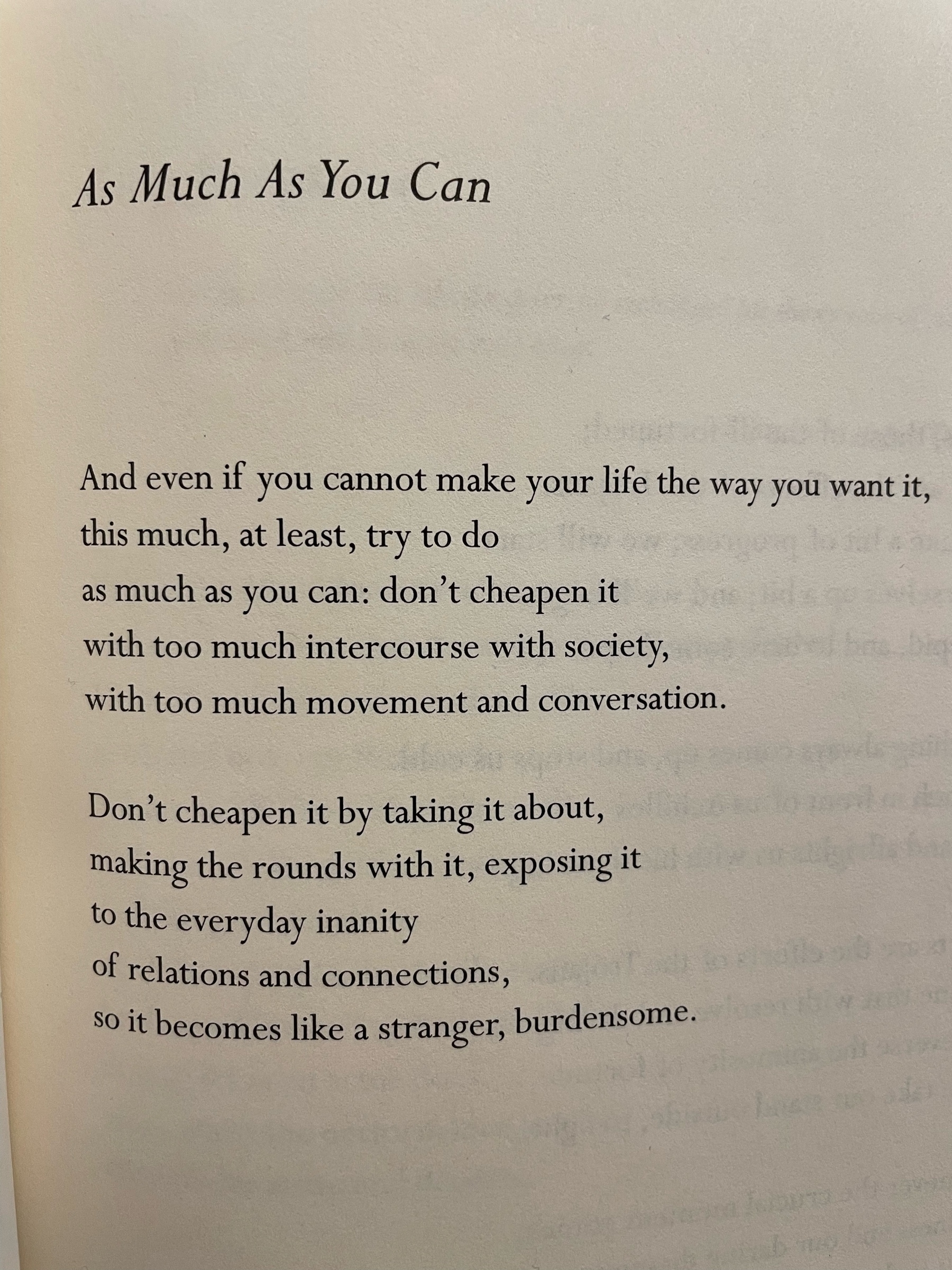

Finished reading: Tradition and Apocalypse by David Bentley Hart 📚
Unsurprisingly if you’ve read much DBH, this is a very strange book. I’d highly recommend chapters 1, 6, & 7 for a compelling vision of Christian belief & practice oriented not just to the past but to the future. The middle chapters on Newman & Blondel? Quite dry by comparison.

Finished reading: London’s Fields by Mark Waldon 📚 ⚽️
A delightful oral history looking at some of London’s football clubs: their histories, rivalries, grounds, & fan bases. I most enjoyed chapters on Orient, Millwall, Brentford, Wimbledon, Fulham, & Charlton—clubs that don’t get much attention state-side.
Review: *The Future of Money: How the Digital Revolution Is Transforming Currencies and Finance* by Eswar S. Prasad 📚

Eswar Prasad, The Future of Money
Reading Eswar Prasad’s The Future of Money was an odd experience. Let’s start by clarifying the author’s starting point. Prasad is the definition of an elite:
I mention all these roles not to impress you, but rather to give you a sense of what to expect from The Future of Money: cryptocurrency filtered through the perspective of someone deeply entrenched in the structures, institutions, and frameworks that define the world as it currently is.
That perspective has some real value: Prasad is a remarkably lucid explicator of those elements of crypto that he cares to understand. For instance, his plain-language explanations of the technical details of Bitcoin and of the distinctions between proof of stake and proof of work are both clear and thorough. They’ve increased my own understanding of the technical details of crypto.
Similarly, and unsurprisingly, Prasad provides an exceptionally interesting overview of the current state of money:
Overall, Prasad’s book shines in explicating how we got to where we are, from a global economic perspective. But Prasad’s perspective has some very obvious and very unsurprising blind spots.
For one, though he refers fairly often to issues relating to privacy, he doesn’t seem to really “get” the degree to which crypto advocates are advocating for *decentralization—*the degree to which crypto is not fundamentally about economics but about politics, governance. He’s skeptical (and rightly so) of claims that Bitcoin and most other cryptos offer privacy and anonymous transactions. But this isn’t what decentralization advocates are getting at. The degree of privacy offered by Bitcoin is still far superior to the degree of privacy offered by the central bank digital currencies (CBDCs) that Prasad thinks are the likely long-term digital-money solution. (To his credit, he’s quick to acknowledge the privacy challenges [quite the euphemism, in this case] that CBDCs present. But he’s certainly nowhere near terrified enough of these challenges for my taste.)
The need for political imagination is also far greater than Prasad acknowledges or seems capable of himself. Prasad wants the global order to remain more or less as it is. But for those less-well-served by this existing order, what are the alternatives? The populist revival? Some sort of web3 or other tech-driven new economic order? Just trudging along trying to survive? Or something even more violent and unsettling? Our economic and social problems need far greater solutions than CBDCs. For all their many flaws, web3 projects do suggest some remarkably creative new economic possibilities.
Do I recommend it? Well, if you have time for 375 pages that ultimately make an inconclusive case for the exisiting global order, sure. But while the economics and history are interesting, Prasad’s political imagination is simply too conventional, too obvious, too elite. The sort of book that tries to convince you that CBDCs are coming, no matter what you do, but don’t worry too much about it.
Incredibly excited for the future of Slant Books. They have some wonderful titles coming in their first year as an indie not-for-profit press. 🔗📚
R.I.P, Robert Bly, one of Minnesota’s great poets. I’ll remember him most for his translations of Thomas Tranströmer; among if not the first translations into English of the incredible Swedish poet. 📚 🔗
Currently reading: The Future of Money: How the Digital Revolution is Transforming Currencies and Finance by Eswar S. Prasad 📚
R.I.P., great author, publisher, and literary scholar Roberto Calasso 📚 🔗

Currently reading: Bill Evans: How My Heart Sings by Peter Pettinger 📚