

Truth vs useful knowledge: Teaching business students *How to Think*
I’m teaching Alan Jacobs’s book How to Think to my business communication students this semester. Communicating and thinking are inseparable, and I’ve always tried and struggled to integrate critical thinking into my course. Previously, I’ve tried using John Lanchester’s How to Speak Money, in addition to assorted essays and excerpts, without much success.
But Jacobs’s book has gone much better so far, because it does something that the other books haven’t: it meets the students where they’re at, in a social-media environment that is shaping their habits of thinking and communicating in ways none of us fully recognizes or understands. We’ve had some encouraging discussions so far trying to sort out these influences and develop the oblique strategies necessary to fight them.
I also recently finished Jacobs’s other recent book, The Year of Our Lord 1943. I’m glad I read it when I did, in the midst of teaching How to Think, because YooL is like the teacher’s guide for HtT. This is especially true teaching it in the setting of a business school at a major public university. Few institutions have been more deeply formed by and reflect more clearly the triumph of technocracy. YooL helps me better understand my institution and my students.
It has also encouraged me in my ever-so-slightly subversive role as a humanist in a business school. I don’t offer extra credit, but if I did, I know now what the assignment would be: having students memorize Under Which Lyre.
I work with a lot of different foreign languages, & Korean is my favorite, hands down. The font we use makes it look like hieroglyphics from the future.
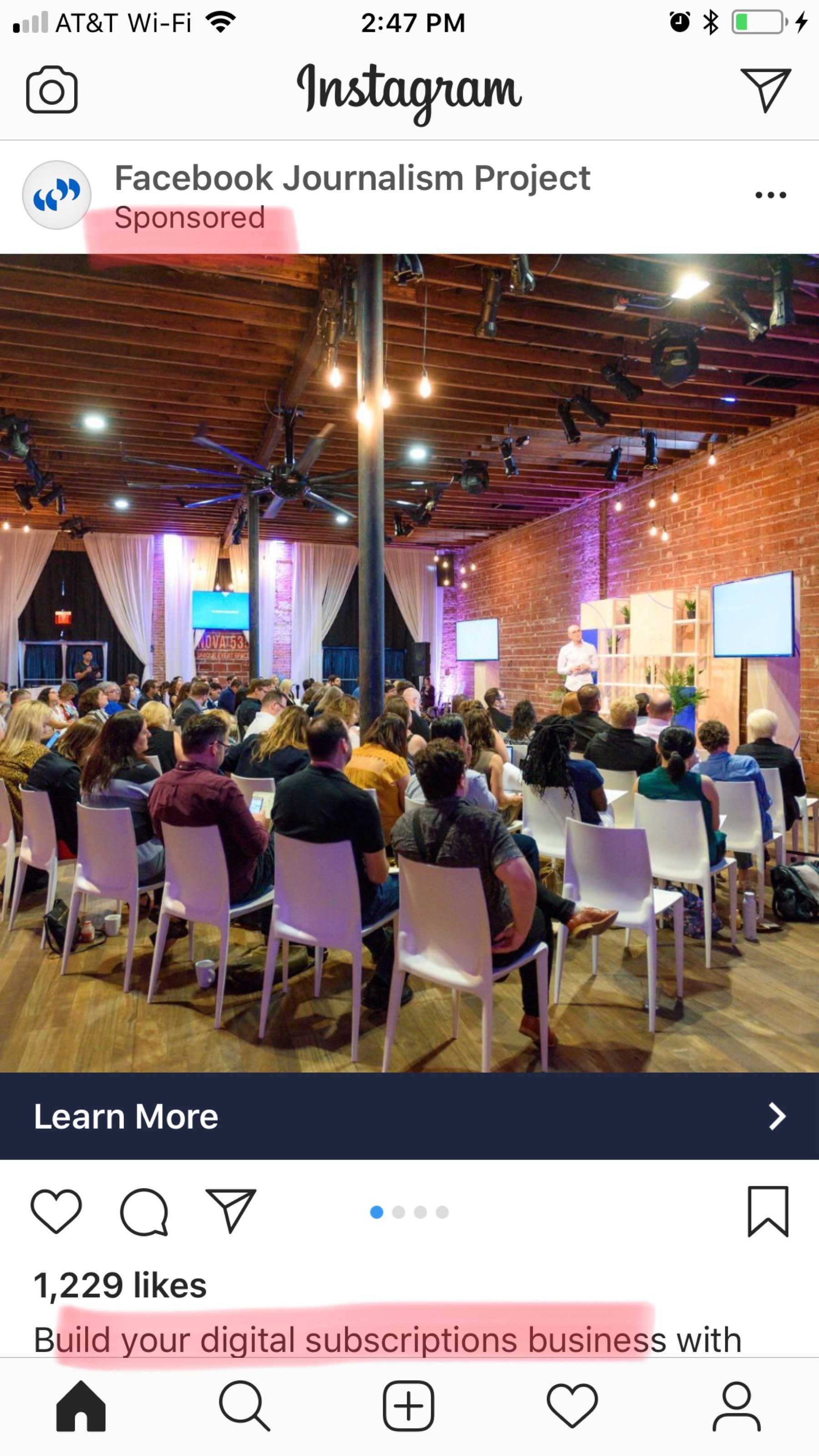
Everything you need to know about Facebook’s understanding of journalism—in one useful ad!
Happy 85th birthday to the great Wayne Shorter! We mere mortals can celebrate by reading Ethan Iverson on Shorter’s transcendental year, 1964.
While you read, listen to his albums from that year: Night Dreamer, Juju, & Speak No Evil. 🎂📚🎶
Craigslist purchase of the year. $30!

In a remarkable essay for NYT Magazine, Ilya Kaminsky revisits Odessa, city of his birth.
Time & silence, Tolstoy’s ears, fathers & mothers & sons, WWII, the essay is about everything, & nothing. (“When I say the word nothing, I name something that is there.”)
Centrist Democrats in the Age of Trump
Yesterday, the NYT published an interesting, and beautifully photographed, article on ND senator Heidi Heitkamp. The piece is framed in terms of the difficulty of her decision to approve or oppose Kavanaugh’s Supreme Court nomination. But by the middle of article, it’s reasonably clear she’ll be one of the Democrats who will approve the nomination; the real issue is the impact of Trump’s misguided trade wars on Midwestern farmers.
The vast majority of electricity used in the world’s data centres comes from non-renewable sources, and as their numbers rapidly increase, there are no guarantees that this will change.
~ John Harris, “Our phones and gadgets are now endangering the planet”
Thoreau in Minnesota. I had no idea about this voyage of Thoreau’s; thanks, @rnv, for the link!
Cavell on citizenship as conversation
Today’s a good day to reflect on the demands of citizenship in our troubled nation. And there’s no better place to start than with this reflection on the centrality of citizenship in the philosophy of Stanley Cavell (R.I.P.):
Cavell … thought that the success of democracy depended on making the enterprise of thinking attractive to people. He showed by example what it meant to think for oneself, and he encouraged his readers to discover and develop their own sensibilities — a prerequisite, as he saw it, to the growth of the kind of individuality necessary for flourishing democratic life.
He also understood American democracy as a demanding ideal that at its best has taken the form of a conversation in which participants model for one another the possibilities of citizenship.
Do read the whole essay.
A sobering look at how tech companies conquered America’s cities, by the excellent Farhad Manjoo. As if I needed any more reasons to move to the country…
Friends in Europe: there is some excellent jazz coming your way this summer. The Billy Hart Quartet (Hart, Ben Street, Mark Turner, and Ethan Iverson) is touring Europe with Joshua Redmon this summer. Make time for this group! 🎶
Trump’s description of his parallel reality unwittingly calls to mind his most reckless and destructive actions, and it shows how oblivious he is to their consequences.
~ Daniel Larison has patiently chronicled the foreign-policy implications of Trump’s reckless presidency.
*Of Farming & Classics: A Memoir* 📚
I recently finished re-reading David Grene’s memoir, Of Farming & Classics. Grene balanced action and contemplation in his life in a truly remarkable way: he spent half the year teaching classics in the University of Chicago’s fascinating Committee on Social Thought, then the other half farming, first on a small farm in Illinois, then back on small farms in his native Ireland.
His memoir is a charming little book. Just 160 pages, it’s focused and delightful, pushing against our assumptions regarding the nature of both farming and education. Since Grene’s life was so focused on these two things, there’s no real struggle between chronology and theme in the book: the two themes run neatly in parallel through his life, from farming in summers and learning Greek as a boy through his remarkable career at the University of Chicago, especially under its idiosyncratic wunderkind president, R.M. Hutchins (who became president of the university when he was 29!).
The final chapter, a defense of fox hunting, feels strangely out of place and disappointingly polemical compared to the rest of the book; this chapter aside, the book deserves its place on my shelf of contemplative, contrarian agrarians, next to his kindred spirit Wendell Berry.
P.S. ~ One of the final pages of the book mentions a recording of Grene reciting passages from Othello; the website pointed to and the bookstore mentioned as sources of the recording are both shuttered. If anyone knows where this recording can be found, I’d be grateful!
Please read my friend Bharat Ranganathan’s essay on Scripture, immigration, and Christian ethics. It’s a good overview of why Jeff Sessions’s comments were so deeply misguided.
So excited for the World Cup, starting today. ⚽️
- My prediction for the final: 🇦🇷 3:2 🇧🇷
- Dark horses: 🇹🇳, 🇨🇷
- And I can’t help but hope that 🏴 will have a great Cup, at least making it to the quarter finals.
Michael Dirda, typically excellent, recommends two recent books on Stoicism and ancient philosophy more broadly.
H/T to him for referring to Farnsworth’s Classical English Rhetoric and Classical English Metaphor, both of which I’d somehow never heard of before tonight. 📚
#CINvMIN ⚽️
My beloved #MNUFC ground out (truly—it wasn’t fun to watch) a US Open Cup win in penalties against FC Cincinnati tonight, thanks to typically great goalkeeping from B🚫bby Shuttleworth, and a pretty lackluster performance from pretty everyone else. I thought Mears was good, and in extra time Ibarra and Danladi both attacked with some energy. But Cincinnati was impressive, and I’m looking forward to having them in MLS soon.
My favorite part of the match was how the fans were chanting “Shuttle-worthless”… then he saved 3 penalties.
View from the desk this morning.